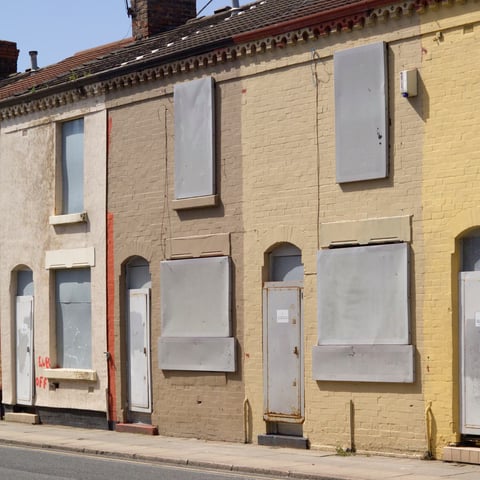
Property owners, investors and developers could face a new annual tax of 7% of market value on certain derelict properties under proposals contained in the Finance (No. 2) Bill 2026. A property valued at €500,000 could attract an annual Derelict Property Tax (DPT) charge of €35,000, before any applicable credits, exemptions or deferrals.
The proposed tax would apply to properties formally identified as derelict within specified built-up areas. It would cover residential buildings as well as properties intended for business, community and other uses. Vacancy alone would not bring a property within scope: the legislation requires it to be both unused and unsuitable for the relevant uses.
Local authorities would identify affected properties and maintain derelict property registers, while Revenue would administer the tax. The first preliminary registers are due by 1 September 2027, with owners able to challenge inclusion before the final registers are published.
The proposed regime could affect the costs of holding, acquiring or redeveloping derelict properties. Owners will need to consider whether their properties meet the statutory criteria, how they would be valued and whether planned remediation works could qualify for a deferral.
Which properties could be affected?
Section 76 of the Bill proposes to insert a new Part 22C into the Taxes Consolidation Act 1997. DPT would apply to properties in specified geographic areas that can reasonably be considered both unused and unsuitable for use. The relevant uses include residential, business, social or community, healthcare, education, transport, utility and recreational purposes.
Indicators of dereliction include boarded-up buildings, missing or materially damaged roofs, loss of weatherproofing, loss of elevations, failing render and insecure brickwork. Certain national monuments and registered historic monuments are excluded.
For preliminary registers published in 2027, the relevant built-up area must have a population of at least 4,000. From 2028, the threshold falls to 2,000. The geographic test is linked to specified Central Statistics Office urban-area mapping and census population data.
How will properties be identified and registered?
Local authorities will identify potentially derelict properties through external inspections and other readily available information. The first preliminary registers must be published by 1 September 2027.
Owners will have until 31 October to appeal inclusion on the grounds that a property is not derelict or that remediation works have commenced. Local authorities must publish their final registers by 28 February of the following year.
A property included on the final register becomes a designated derelict property for DPT purposes. Revenue will administer valuation, returns, collection and enforcement.
How will DPT be calculated and paid?
DPT will be charged annually at 7% of market value. The valuation date will generally be the first liability date on which DPT applies to the owner, with a new valuation applying for each successive three-year period.
The annual liability date is 1 March, with returns due by 23 June. The liable person will generally be the owner on the liability date. Where there is more than one liable person, the owners will be jointly and severally liable.
Credits may be available for Local Property Tax and Vacant Homes Tax actually paid, subject to statutory conditions. Each credit is capped at the DPT otherwise payable, and any excess cannot be repaid or carried forward or back.
Deferrals and exemptions
Where qualifying remediation works have commenced, DPT arising after commencement may be deferred. If planning permission is required, a commencement notice must have been lodged with the local authority. In other cases, the works themselves must have commenced.
The deferral continues until the earlier of a change in ownership or the applicable statutory deadline. Where that deadline is not governed by a planning-permission period, it will generally be 17 months after the first liability date following commencement of the works.
If remediation is completed and the local authority confirms that the property is no longer derelict, the deferred DPT may cease to be payable.
The Bill also provides for a separate purchaser deferral. Where ownership changes on or after 1 January 2026, the buyer and seller are unconnected, and remediation has not commenced before the relevant liability date, the purchaser may claim a deferral for the first liability date after acquisition.
This generally continues until the earlier of another change in ownership or 12 months after that liability date. If qualifying remediation begins within that period, the liability may move into the wider remediation deferral regime.
Other provisions include an exemption for certain properties affected by defective concrete blocks, subject to detailed conditions, and deferrals where a relevant court order prevents sale or remediation, while specified appeals, judicial reviews or defective-block applications remain unresolved, or in certain circumstances following the death of a liable owner.
Annual DPT returns must still be filed to access a number of these exemptions and deferrals, including while a remediation deferral is claimed.
Property transactions, valuations and compliance
Before completing a sale, an owner must pay outstanding DPT and accrued interest, address any penalty due and file a separate return with Revenue. Unpaid DPT and interest remain a charge on the property.
The Bill provides for surcharges where the returned property valuation is substantially below the ascertained market value:
Late returns may attract a 5% surcharge, capped at €12,695, increasing to 10%, capped at €63,485, after two months. Overdue DPT carries simple interest at 0.0219% per day or part of a day.
Next steps
Although the Bill provides for the registration process to begin in 2027, DPT will not automatically become operational on 1 January 2027. Section 76 will take effect on the day or days appointed by the Minister for Finance, with different commencement dates possible for different provisions or purposes.
Property owners, investors and developers should review potentially affected properties, assess their condition and consider planned remediation, redevelopment or disposal. This includes reviewing available exemptions and deferrals, retaining evidence of qualifying works and establishing supportable market valuations.
This analysis is based on the Finance (No. 2) Bill 2026 as initiated on 19 October 2026. The provisions may change as the Bill progresses through the legislative process.
About our team
Meet the author
Robert is a tax partner with over 15 years of experience. Robert specialises in the provision of tax advisory and compliance services to domestic and international clients including management companies, investment advisors, institutional investors, asset managers, PE houses, administrators, custodians, promoters and distributors.